

Study Insights


The Order of the Lord’s House (June 4, 1833)
A Moment of Sacred Organization
Doctrine and Covenants 96 stands as a remarkable revelation that bridged both the temporal and the spiritual needs of the early Latter-day Saints. Revealed on June 4, 1833, in Kirtland, Ohio, it addressed not only property and land management but also deeper principles of consecration and stewardship. The Church at this time was expanding rapidly, and new converts were gathering to Kirtland, forming the heart of the Saints’ community. With this growth came an urgent need for order — both in constructing sacred spaces and in managing the resources entrusted to them. Section 96 provided that divine order, outlining how land should be used for the glory of God and the welfare of His people.
Historical Background of Kirtland in 1833
In early 1833, the Saints were fully engaged in building Zion. Kirtland served as the headquarters of the Church, where revelation flowed and where spiritual experiences shaped the foundation of the Restoration. The Saints had recently been commanded to construct the Lord’s house — the Kirtland Temple — as a center for instruction, endowment, and worship. However, the land necessary for these endeavors was not yet properly organized. The French farm, an important tract of land near Kirtland, had been acquired by the Church, but confusion lingered about its management and use. Section 96 was given to clarify these matters, ensuring that the Lord’s work could continue without contention or delay.
The French Farm and the Bishop’s Stewardship
The “French farm” mentioned in the revelation was more than just property — it symbolized the collective sacrifice of the Saints. Purchased through consecrated funds, this land was meant to support the building of Zion. In Section 96, the Lord directs that the farm be divided and managed under the direction of the bishop, Edward Partridge, and the United Firm — a group of Church leaders responsible for overseeing the Church’s financial and temporal affairs. This instruction emphasized the principle that temporal stewardship must align with spiritual purpose. The bishop’s role was not that of an owner but of a caretaker, ensuring that all resources were used according to divine will. Through this, the Saints were reminded that everything they possessed ultimately belonged to God, and managing it wisely was an act of faith.
The United Firm and the Principle of Order
The revelation also reaffirmed the importance of the United Firm, which included key leaders such as Joseph Smith, Sidney Rigdon, and Frederick G. Williams. The Lord designated these men to act in harmony in managing Church property and resources. Section 96’s counsel reinforced the idea that order and unity were central to the progress of God’s kingdom. It taught that spiritual growth cannot thrive in disorganization or discord. The United Firm was not simply a financial body — it was a sacred trust that linked consecration with cooperation. In this way, Section 96 became a guide for the Church’s early economic system, teaching that the Lord’s work must be built upon principles of fairness, faith, and accountability.
The Spiritual Lessons Behind Temporal Direction
While Section 96 may appear administrative on the surface, its underlying spiritual message runs deep. It teaches that the Lord is concerned with every detail of His work — even matters of land and finance. To Him, there is no divide between the sacred and the practical when both are dedicated to building His kingdom. The early Saints were learning that spiritual maturity involves consecrating not only one’s heart but also one’s hands, resources, and possessions. Every field, every building, every act of labor could become holy when offered to the Lord. In this sense, Section 96 was not merely about the French farm but about forming a covenant relationship between heaven and the earth — where stewardship became a form of worship.
Preparing to Build the House of the Lord
This revelation arrived at a critical juncture in Church history — just as plans for the Kirtland Temple were being drawn and construction was about to begin. The Lord’s emphasis on order and consecration in Section 96 foreshadowed the precision and unity required for the temple’s completion. The command to dedicate specific lands and manage them wisely was, in part, a spiritual preparation for what would take place within those sacred walls. The Kirtland Temple would soon stand as a testament to the Saints’ obedience to revelations like this one, a physical representation of their covenant to use all things — both temporal and spiritual — for God’s glory. Section 96 thus paved the way for one of the most sacred accomplishments of the Restoration.
The Broader Symbolism of Consecration
At its heart, Section 96 embodies the eternal principle of consecration — the act of dedicating one’s time, talents, and means to the service of God. The early Saints’ willingness to sacrifice for land and temples reflected their faith in divine promises. Even in their poverty, they understood that the Lord’s work required not just devotion but practical effort. This revelation revealed that holiness does not come from separation from the world but from sanctifying everyday labor. To the faithful, plowing fields, managing property, and building temples were all part of the same sacred calling. The Lord’s instructions about the French farm became a pattern for how Saints today can dedicate every aspect of life — financial, professional, and personal — to the service of heaven.
Modern Reflections and Enduring Relevance
Though centuries have passed since June 1833, the principles of Section 96 remain relevant. In a world of abundance and self-interest, the revelation’s message of stewardship and consecration feels timeless. It reminds us that true discipleship extends beyond belief — it encompasses how we manage what we’ve been given. Whether it’s a plot of land, a business, or personal resources, the Lord expects His people to use them wisely and selflessly. Section 96 invites modern readers to see property not as possession but as stewardship, and to find holiness in order, discipline, and purpose. When our efforts are aligned with divine direction, even ordinary responsibilities become sacred callings.
The Everlasting Order of Zion
Doctrine and Covenants 96 closes with a vision of harmony — a community bound by faith, order, and consecration. It’s a reminder that Zion is not merely a place but a way of life. The Lord’s people build Zion every time they organize their lives around His will, serve with pure intent, and consecrate their labors for the greater good. In 1833, these instructions prepared the Saints to build a temple. Today, they prepare individuals and communities to build a spiritual Zion within their hearts and homes. Section 96, though brief, stands as a timeless call to order, faith, and devotion — an invitation to make every field and every effort holy before the Lord.
Learn More about D&C 96 – Recommended Articles
For those seeking deeper understanding of Section 96 of the Doctrine and Covenants, the following recommended articles from Church sources and academic publications provide valuable insights into the Kirtland stake of Zion, the management of inheritances, the United Firm, and the Lord’s word going forth.
- Doctrine and Covenants 96 (Full Text) , ChurchofJesusChrist.org.
- “Section 96 — This Stake Should Be Made Strong” , ChurchofJesusChrist.org Student Manual.
- “Section 96 – Doctrine and Covenants Contexts” , BYU Studies.
Talks by Church Leaders on D&C 96
While there may not be many talks focused exclusively on Section 96, the following relate to its themes of Zion organization, stewardship of lands, and the Lord’s word going forth.
More Verses
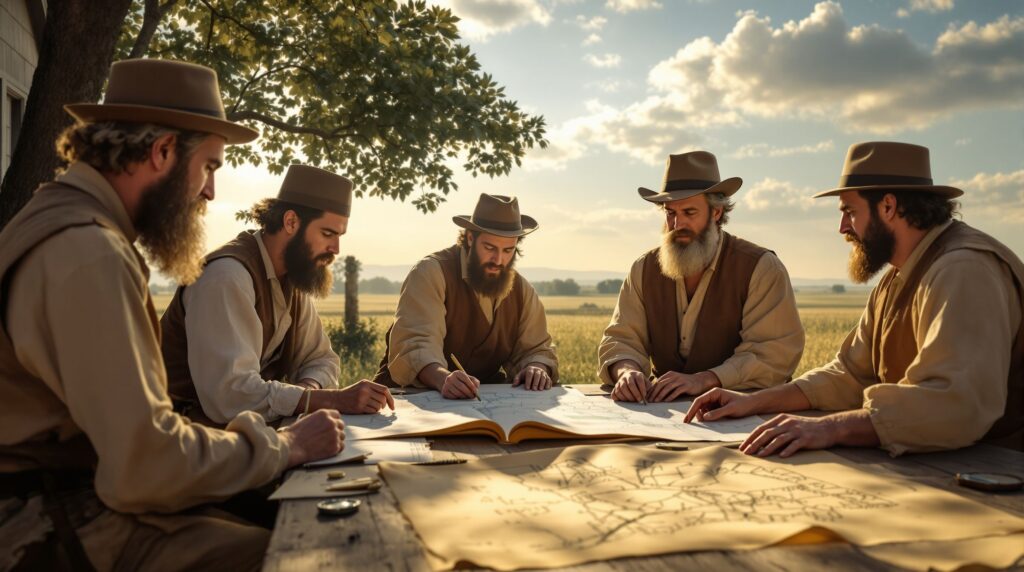
D&C Section 96:3-4
What does it mean to divide land “according to wisdom”? In D&C 96:3–4, the Lord taught early Saints in Kirtland that every earthly decision could serve a divine purpose. Through consecration and order, even property management became part of building Zion and bringing forth God’s word to the world.

D&C Section 96:6-7
What does it mean to divide land “according to wisdom”? In D&C 96:3–4, the Lord taught early Saints in Kirtland that every earthly decision could serve a divine purpose. Through consecration and order, even property management became part of building Zion and bringing forth God’s word to the world.
Doctrine and Covenants 96
Revelation given to Joseph Smith the Prophet, June 4, 1833. The occasion was a conference of high priests, and the chief subject of consideration was the disposal of certain lands, known as the French farm, possessed by the Church near Kirtland. Since the conference could not agree who should take charge of the farm, all agreed to inquire of the Lord concerning the matter.
1, The Kirtland Stake of Zion is to be made strong; 2–5, The bishop is to divide the inheritances for the Saints; 6–9, John Johnson is to be a member of the united order.
1 Behold, I say unto you, here is wisdom, whereby ye may know how to act concerning this matter, for it is expedient in me that this stake that I have set for the strength of Zion should be made strong.
2 Therefore, let my servant Newel K. Whitney take charge of the place which is named among you, upon which I design to build mine holy house.
3 And again, let it be divided into lots, according to wisdom, for the benefit of those who seek inheritances, as it shall be determined in council among you.
4 Therefore, take heed that ye see to this matter, and that portion that is necessary to benefit mine order, for the purpose of bringing forth my word to the children of men.
5 For behold, verily I say unto you, this is the most expedient in me, that my word should go forth unto the children of men, for the purpose of subduing the hearts of the children of men for your good. Even so. Amen.
6 And again, verily I say unto you, it is wisdom and expedient in me, that my servant John Johnson whose offering I have accepted, and whose prayers I have heard, unto whom I give a promise of eternal life inasmuch as he keepeth my commandments from henceforth—
7 For he is a descendant of Joseph and a partaker of the blessings of the promise made unto his fathers—
8 Verily I say unto you, it is expedient in me that he should become a member of the order, that he may assist in bringing forth my word unto the children of men.
9 Therefore ye shall ordain him unto this blessing, and he shall seek diligently to take away incumbrances that are upon the house named among you, that he may dwell therein. Even so. Amen.